
Retail and Commerce Ecosystem
Integrated platform program to combine stores, e-commerce, marketplace, loyalty, fulfillment and partner offers in one commerce platform.
This service page is written like a working article: start with the business fit, inspect the scope, then use the process and deliverables to decide whether the engagement is ready.

Executive overview
Retail and Commerce Ecosystem is a connected portfolio of products, shared platform capabilities, data, identity, partner relationships and governance that lets users move across several services as one coherent experience. Integrated platform program to combine stores, e-commerce, marketplace, loyalty, fulfillment and partner offers in one commerce platform. The service is positioned as a business outcome rather than a list of features: discovery establishes the baseline, the first release proves one valuable end-to-end result, and subsequent releases extend capability only when evidence supports the investment.
A strong engagement connects strategy, user experience, operations, technology or production, governance and measurement. It gives the client a usable result, a clear owner, documented decisions and a way to see whether the result is improving.
What it is
At its core, Retail and Commerce Ecosystem provides a controlled method for turning an identified need into a repeatable capability. The exact scope varies by company, but the service should always define inputs, roles, journeys, decisions, outputs, dependencies, exceptions and measurable acceptance criteria. It may be delivered as a standalone initiative, a module in a larger platform or ecosystem, a modernization program, or an ongoing managed capability.
What it does in practice
In practice, the service maps the current state, removes ambiguity, designs the target experience or operating model, produces the required solution or assets, validates quality, launches through a controlled plan and measures the result. It should reduce avoidable manual work and decision friction while improving clarity, consistency and accountability.
Which companies it suits
It is suitable for groups of companies, financial institutions, telecoms, marketplaces, governments, education or healthcare networks and ambitious platform businesses that can create more value by connecting products and partners.
Retailers, marketplaces, restaurants, hospitality groups, travel companies and direct-to-consumer brands are common clients.
Who uses it
Users include customers, employees, merchants, suppliers, developers, institutions and partners. Platform, product, data, risk, finance, operations and ecosystem-development teams govern the shared capabilities.
Users may include shoppers, guests, sellers, merchants, store or venue teams, fulfillment staff, service agents and commercial managers.
Why companies need it
- 01Products use separate identities, data models, payments, support and loyalty.
- 02Customers repeat onboarding and cannot move smoothly between services.
- 03Partners face high integration cost and inconsistent commercial rules.
- 04Business units optimize locally while the group loses cross-service value.
- 05No governance exists for shared capabilities, data rights, economics or platform standards.
Core capabilities
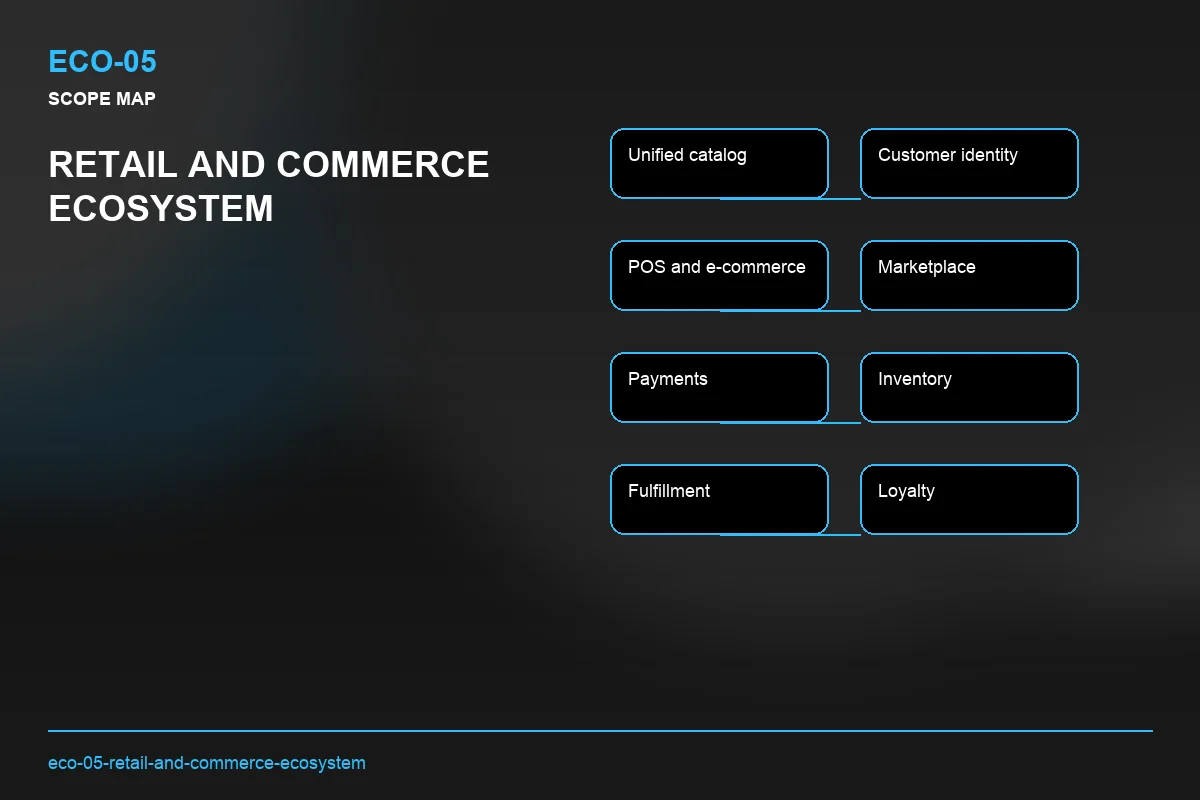
- 01Unified catalog — creates a governed, searchable structure so people find the right item, version and context quickly.
- 02Customer identity — defines who may see, create, change, approve or export information and leaves an auditable trail.
- 03POS and e-commerce — is specified as a practical capability with inputs, owners, outputs, exceptions, dependencies and acceptance criteria.
- 04Marketplace — is specified as a practical capability with inputs, owners, outputs, exceptions, dependencies and acceptance criteria.
- 05Payments — controls financial events, calculation rules, status, exceptions and reconciliation from source to record.
- 06Inventory — is specified as a practical capability with inputs, owners, outputs, exceptions, dependencies and acceptance criteria.
- 07Fulfillment — is specified as a practical capability with inputs, owners, outputs, exceptions, dependencies and acceptance criteria.
- 08Loyalty — is specified as a practical capability with inputs, owners, outputs, exceptions, dependencies and acceptance criteria.
- 09Commerce analytics — turns operational data into role-specific visibility, trends, alerts and decisions rather than a passive report.
Each capability must be connected to the service outcome and tested in a complete user or operating scenario.
Typical use cases
- 01Replace a fragmented or inconsistent current approach with one governed end-to-end experience.
- 02Launch a new customer, employee, partner or market capability with measurable acceptance criteria.
- 03Modernize an existing solution, process or content system without losing critical operations or brand equity.
- 04Connect Unified catalog, Customer identity, POS and e-commerce to reporting, ownership and a repeatable improvement cycle.
- 05Create a reusable foundation that can expand into new segments, channels, products or ecosystem services.
Business value and expected outcomes
The main value is not the artifact alone. It is the improved business behavior created by that artifact: faster and more reliable execution, a clearer customer or employee journey, stronger quality, better evidence for decisions and a foundation that can be maintained. The business case should link the service to revenue enabled, cost avoided, risk reduced, time saved, quality improved or strategic capability created.
How the service is delivered
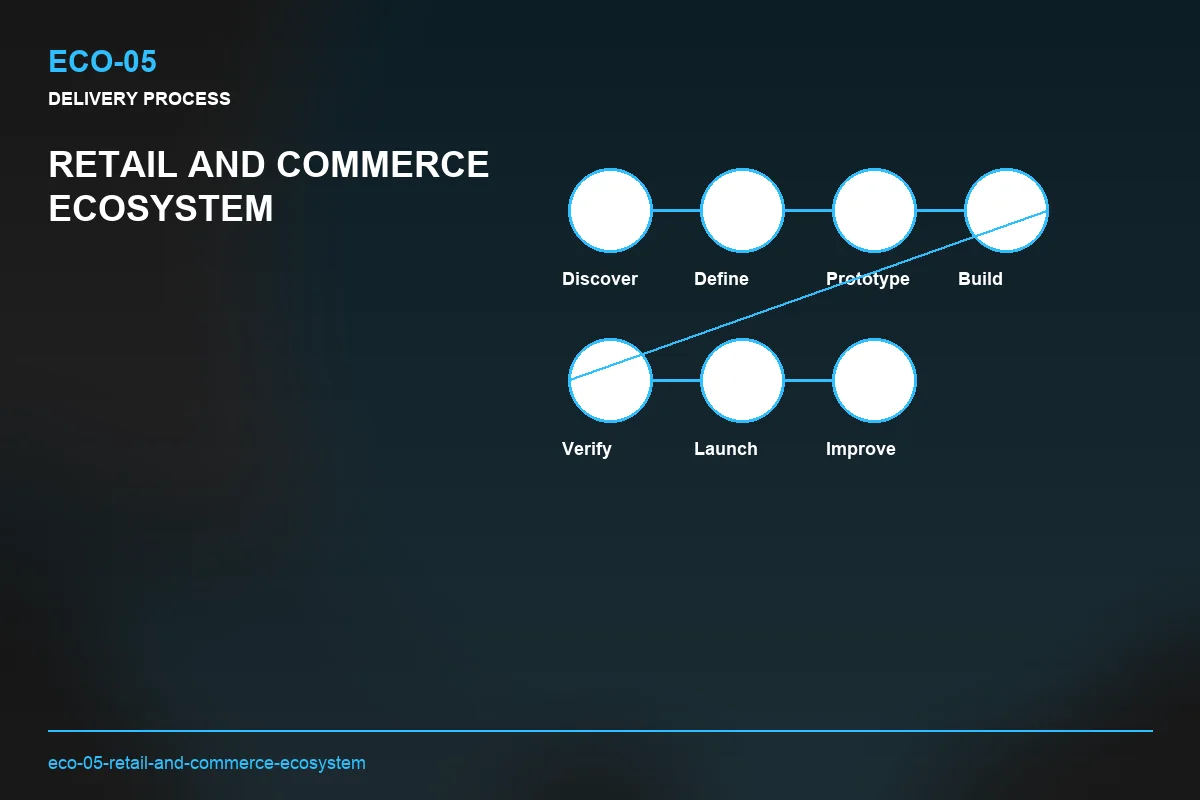
1. Outcome discovery
Define the business problem, audience, baseline, constraints, decision owner and measurable acceptance criteria.
2. Research and current-state analysis
Study users, processes, data, competitors or references, existing technology and operational evidence.
3. Solution definition
Agree scope, journeys, capabilities, content, architecture or production approach, integrations and non-functional requirements.
4. Prototype or proof
Validate the riskiest assumptions with a prototype, sample, pilot, test dataset, style frame or technical spike.
5. Production and quality assurance
Build or produce the approved scope with documented reviews, version control, testing and stakeholder checkpoints.
6. Launch and enablement
Release through a controlled plan, migrate or publish required assets, train owners and activate analytics and support.
7. Measurement and improvement
Review outcomes against baseline, resolve issues and prioritize the next release, campaign or optimization cycle.
Typical deliverables
- 01Outcome brief, baseline and success scorecard
- 02User, stakeholder and operating-context map
- 03Requirements, journeys, workflows or creative/technical specification
- 04Prototype, proof, sample or validated design direction
- 05Production-ready implementation or final master assets
- 06Quality-assurance, security, accessibility or delivery checklist
- 07Analytics and measurement specification
- 08Training, handover, support and improvement backlog
Data, security, quality and governance
The project should use least-privilege access, clear ownership, version history, documented approvals and safe handling of personal, confidential or licensed material. Accessibility, privacy, security, intellectual-property rights, retention, auditability and market-specific regulation must be reviewed according to the actual scope. Availability, pricing, payments, refunds, customer identity, fraud, service recovery and peak-load behavior require special attention. Quality must be demonstrated with evidence: tests, review records, approved samples, evaluation sets, analytics or acceptance scenarios—not adjectives.
KPIs and measurement plan
| KPI | What to record |
| Active services per user | Baseline, target, actual, period, segment, data owner and source system |
| Cross-service conversion and retention | Baseline, target, actual, period, segment, data owner and source system |
| Shared identity or wallet adoption | Baseline, target, actual, period, segment, data owner and source system |
| Partner activation and transaction volume | Baseline, target, actual, period, segment, data owner and source system |
| Reuse of common platform capabilities | Baseline, target, actual, period, segment, data owner and source system |
| Ecosystem revenue mix and contribution | Baseline, target, actual, period, segment, data owner and source system |
Recommended charts
- 01Baseline vs target — Grouped bar chart: Compare the verified starting value, agreed target and actual result for the two or three most important KPIs.
- 02Performance over time — Line chart: Plot weekly or monthly performance with annotations for launches, process changes and major campaigns.
- 03Journey or workflow conversion — Funnel chart: Show volume and conversion through the critical stages, including exceptions and abandonment.
- 04Quality and operational mix — Stacked bar or heatmap: Break results down by channel, role, segment, location, device, content type or exception category.
Statistics and evidence policy
Do not publish invented market percentages, ROI claims or benchmark numbers. Every numeric claim must store the source URL, publisher, publication date, geography, sample or methodology, and the date it was checked. Client performance charts should use verified first-party data and label baseline, target, actual, period and owner. Until evidence is available, the article should show the chart title and required fields with values marked TBD, never fabricated sample numbers.
When it is not the right purchase
Do not buy Retail and Commerce Ecosystem only because it is fashionable, because a competitor has it, or because the organization wants a large feature list. It is not ready for implementation when there is no accountable owner, no access to users or data, no decision process, no capacity to adopt the result, or no agreement on success. In those cases, begin with a diagnostic or discovery engagement.
Commercial packaging
- 01Discovery: A paid, time-boxed engagement that produces evidence, scope, priorities, risks, estimate and an implementation recommendation.
- 02MVP or first production release: The smallest complete version that delivers one valuable end-to-end outcome with analytics and acceptance criteria.
- 03Scale: Additional segments, modules, integrations, formats, markets, automation, performance and governance.
- 04Managed improvement: Ongoing support, content or production capacity, monitoring, experiments, reporting and quarterly prioritization.
Discovery questions
- 01Which measurable business or audience outcome must change first?
- 02Who creates, checks, approves, uses and owns the result?
- 03What is the current baseline and where can it be verified?
- 04Which journeys, formats, modules or decisions are mandatory for the first release?
- 05What systems, data, brand rules, regulations or vendors constrain delivery?
- 06Which failure would create the greatest commercial, operational or reputational risk?
- 07How will the result be measured at 30, 90 and 180 days?
Frequently asked questions
How long does it take?
Timing depends on research depth, scope, dependencies, approval speed, integrations and quality requirements. Discovery should produce a phased estimate rather than a promise based only on the service name.
Can it start as an MVP?
Yes, when the MVP contains one complete valuable journey, clear exclusions, production controls and a measurement plan. A collection of disconnected screens or assets is not an MVP.
Can it integrate with our current tools?
Usually yes. Every integration should identify the system of record, authentication, fields, frequency, error handling, ownership and reconciliation method.
How is quality accepted?
Acceptance is based on agreed scenarios, technical or creative specifications, accessibility and security checks, performance thresholds and stakeholder sign-off.
What does the client need to provide?
A decision owner, subject experts, access to users and evidence, current assets or systems, timely feedback, legal or compliance input and accountable owners after launch.
Overview and fit
The overview explains when this service is worth buying, what type of client should use it, and which assumptions must be clarified before a serious proposal.
Integrated platform program to combine stores, e-commerce, marketplace, loyalty, fulfillment and partner offers in one commerce platform.
Unified catalog / Customer identity / POS and e-commerce
Ideal client
- 01A team with a defined outcome but unresolved scope
- 02A founder or operator preparing a governed launch
- 03A sales team that needs clear discovery inputs before commitment
Scope and capabilities
Scope is broken into modules so the engagement can be estimated, accepted and handed over without hiding critical work inside vague language.
Modules
Problems solved
Unified catalog
Customer identity
POS and e-commerce
Marketplace
Payments
Inventory
Fulfillment
Loyalty
Commerce analytics
Delivery process
The process is intentionally linear. Each step produces evidence before the next one starts, which keeps decision-making clear for founders, operators and internal teams.
- 01
Discovery and brief
- 02
Blueprint and prototype
- 03
Production or development
- 04
Quality and acceptance
- 05
Launch and handover
- 06
Optimization and support
Deliverables
Deliverables are grouped by product, handover and support so the final package is explicit rather than implied.
Product
Approved brief and scope
Architecture, treatment or prototype
Production-ready implementation or final masters
Quality and acceptance evidence
Handover
Versioned source package where contracted
Technical and usage documentation
Rights and provenance register for media
Training and ownership handover
Support
Launch or publishing support
Monitoring and issue-response plan
Improvement backlog
Optional managed service or studio retainer
Engagement models
Engagement models describe how this service can start small, move into production, or continue as a managed improvement path.
Discovery sprint
Core build or production phase
Launch support
Managed improvement retainer
KPIs to define
KPIs keep the project accountable. They should be agreed before production so acceptance is based on evidence, not taste alone.
Qualified inquiry quality
Time from brief to accepted scope
Launch readiness and acceptance coverage
Post-launch improvement backlog health
Related services
Related services help compose a larger delivery path when the current service is only one piece of the system.
Enterprise Digital Ecosystem
Integrated platform program to unify customers, employees, partners, data and operations across the enterprise.
ECO-02Fintech Ecosystem
Integrated platform program to connect payments, banking, lending, commerce and partner services around a trusted financial identity.
ECO-03Healthcare Ecosystem
Integrated platform program to coordinate patients, providers, laboratories, pharmacies, insurers and public-health services.
ECO-04Education Ecosystem
Integrated platform program to connect learners, families, educators, institutions, employers and content providers across lifelong learning.
DEV-01Digital Product Strategy and Discovery
Turn an idea or business problem into a validated product direction, prioritized roadmap and investment case.
DEV-02Custom Software Development
Design and build software tailored to the client’s workflows, data, integrations and commercial model.
Next step
Start a project inquiry
Select the desired outcome, audience, platforms, languages, launch window and known constraints. Complex work begins with a focused discovery or concept phase.
Start a project inquiry